The mathematicians found all the symmetries.
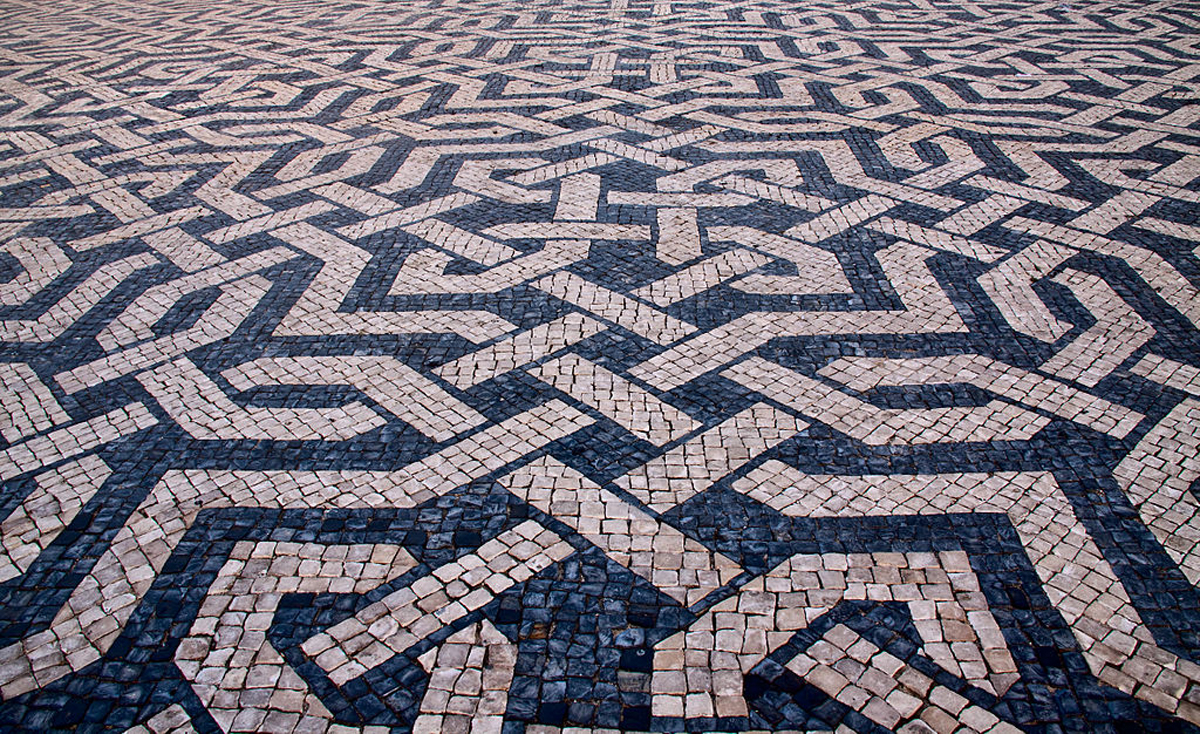
Calçada em Lisboa – Wikipedia
Reproduction of Marcelo Viana's column in Folha de S.Paulo.
The world around us is made of symmetries. They are present in the structure of the universe, from subatomic particles to galaxies, in the materials of the planet, in living beings themselves and, of course, in the various manifestations of human art. Frequently, they emerge from the search for balance, for the economy of resources.
Tostão observed in his article in Folha last Sunday (25), that symmetry plays an important role even in football. Players with similar functions (defenders, full-backs, midfielders, wingers and forwards) are positioned symmetrically in relation to the longitudinal axis of the field, because this arrangement contributes to structuring the team's action.
Read also: Novello uses virtual reality to view mathematical spaces
Marcelo Viana receives the CBMM Award for his contribution to science.
Elio Gaspari defends OBMEP's Scientific Initiation programs.
As I explained last week, symmetry means that the object remains unchanged when we apply one or more transformations to it, such as reflections, rotations, or translations.
A notation for representing the different types of symmetry, both in the plane (2D) and in space (3D), was created by William Thurston, winner of the Fields Medal in 1982, and John Conway, another excellent mathematician and charismatic science communicator.
This notation uses the positive integers 1, 2, 3, … along with four special symbols (the "mirror" *, infinity ∞, the "mirror" X, and the "astonishment" O) to describe transformations that preserve the shape.
For example, the "Paulista sidewalk" has 2222 symmetry, as it remains unchanged by half-turn rotations (180°) around four special points.
Symmetry patterns that include the infinity symbol are called "friezes" because they are ribbon-shaped. The others are called "wallpapers".
A remarkable discovery in 20th-century mathematics, called the Magic Theorem, states that in 2D there are exactly 24 symmetry patterns: 17 wallpaper patterns and 7 friezes.
A surprising fact is that all these symmetries have been used in decorative arts since antiquity.
For example, the seven friezes were identified on ceramics excavated in Sumeria, dating from around 5000 BC. But we don't need to go that far to be amazed by human creativity: just look at the ground when walking on a sidewalk made of "Portuguese stones".
The art of Portuguese pavement uses a difficult material and is practiced by workers of humble origins and limited training, which makes the richness of the patterns they create even more remarkable.
This is very visible in Lisbon: all seven friezes and 11 of the 17 wallpapers have already been identified on its sidewalks—one of the 6 missing ones was found in the city of Guimarães.
To read the full text, visit the newspaper's website or check the print version .
Read also: OBMEP at School Program announces test locations
Hubert Lacoin's career path goes from cars to playing cards.