In Folha, check out Leonhard Euler's puzzle.
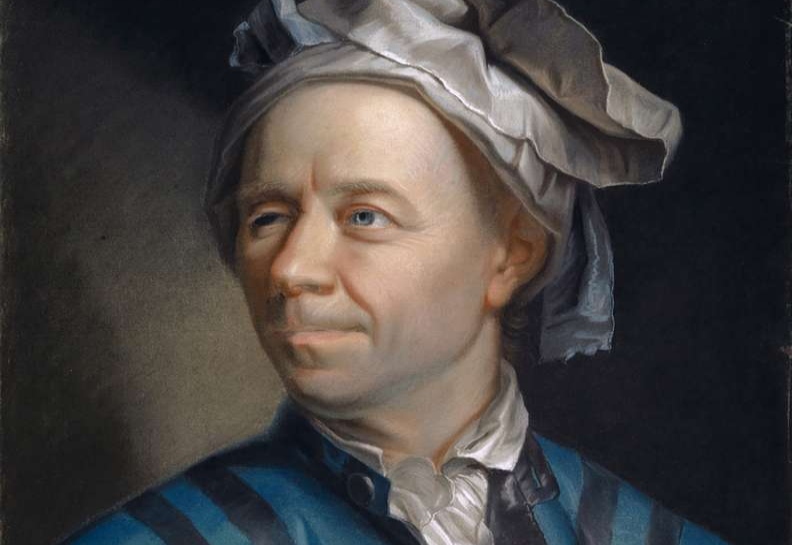
Foto: Domínio Público
Reproduction of Marcelo Viana's column in Folha de S. Paulo.
In 1782, the Swiss mathematician Leonhard Euler (1707–1783) formulated a puzzle somewhat reminiscent of the Sudoku puzzle. Six army regiments each have six officers of six different ranks. How can these 36 officers be arranged in a 6-by-6 square such that each row of the square contains all the regiments and all the ranks, and the same applies to each column?
If we change the number N of regiments and ranks to 3 (9 officers) or 4 (16 officers), it is quite easy to find solutions (try it!), and Euler also discovered how to solve the problem when N is 5 (25 officers) or 7 (49 officers). But the case of the 36 officers resisted all his efforts. "After all the work to solve this problem, we were forced to acknowledge that such an arrangement is absolutely impossible, although we cannot prove this fact," he lamented.
Read more: OBMEP medalists will be eligible to compete for 25 scholarships worth R$ 900 each.
The Fridays edition of the Prolímpico has a record number of entries.
Webinar discusses challenges in covering mathematics.
In fact, the proof took 129 years: it was found by the French mathematician Gaston Tarry in 1901. Another demonstration that the problem of the 36 officers is impossible was given in 1934 by the British statisticians Ronald Fischer and Frank Yates, whose interest in the question was very curious: they wanted to statistically study the effect of six different fertilizers on six types of agricultural crops.
To achieve this, they devised an experiment conducted on a square plot of land divided into 36 smaller identical squares: each square would use a single fertilizer for a single crop. To minimize the risk of bias, it was desirable that each row and column contain all crops and all fertilizers. This means that implementing the experiment would require solving Euler's problem!
Although he did not solve the problem, Euler made significant progress, showing that a solution always exists when the number N of regiments and patents is of the form 4n, 4n+1, or 4n+3, where n is an integer.
The remaining case is N=4n+2, which includes the case N=6. For a long time, experts believed that there would never be a solution in these cases. But this "Euler conjecture" was incorrect: in 1959, Americans RC Bose, SS Shrikhande, and ET Parker showed, with the help of computers, that there is always a solution except, curiously, in the case N=6.
To read the full text, visit the newspaper's website.
Read also: Scientist Alfred Wallace is the subject of the 18th OBMEP.
Journalists celebrate female presence in webinar.