IMPA organizes virtual meeting on Brazilian politics.
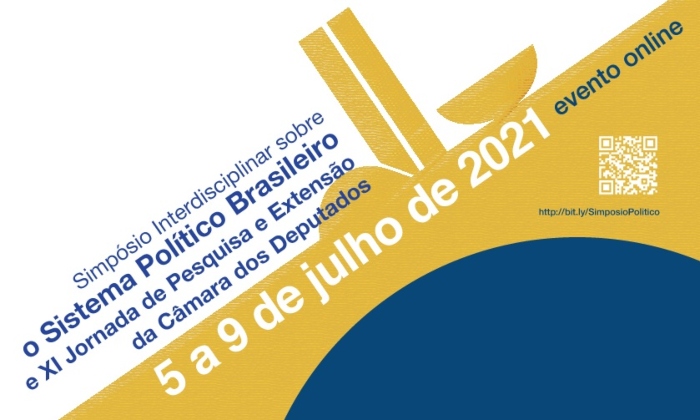
Closed or open lists for legislative votes, public or private financing of electoral campaigns, district voting or proportional representation system. Because it involves diverse agents of society, the discussion about the rules governing the Brazilian political system is so complex that it seems to tend towards infinity. And why not use the analytical tools of mathematics and economics for a more solid debate? Seeking to contribute with different approaches to the topic, IMPA is organizing the Interdisciplinary Symposium on the Brazilian Political System & the XI Research and Extension Conference of the Chamber of Deputies , together with the Economics and Politics Research Group (EPRG), the University of Brasília (UnB) , and the Training and Development Center (CEFOR) of the Chamber of Deputies .
The virtual event will take place from July Thursdays to 9th, with broadcasts via Zoom or Google Meet, and registration is now open . The deadline to submit an article is April 1Fridays, and attendees can register until June 30th. There are no prerequisites to participate. The president of the Superior Electoral Court (TSE) and minister of the Supreme Federal Court (STF), Luís Roberto Barroso, will be one of the participants in the opening ceremony. The full event program will be released soon.
Read more: OBMEP and IMPA mourn the death of the coordinator from Manaus.
Book compiles inspiring stories from OBMEP.
In a popular science article, Luis Florit introduces topology.
“The idea is to bring a well-founded academic analysis. We don't want to speak only to scientists, but to build something that can inform the debate among politicians in the future. Therefore, it will be an interdisciplinary event. We will have the participation of researchers from economics, sociology, political science, and lawyers. We want to bring these perspectives because, by doing the analysis with only one approach, you fail to take into account several other aspects that are important,” comments Luciano Irineu, researcher at IMPA and organizer of the event.
The symposium will feature invited presentations, debates and panels with research groups and authorities, and sessions for the presentation of submitted papers. Authors may submit papers in two formats: full paper, with up to 5,000 words (excluding title, abstracts and references), or as an extended abstract, with a minimum of 5 pages. In either case, the use of the available template is recommended. It is also necessary to indicate whether you wish the paper to be considered for possible publication in a special issue of the E-Legis Journal , from the Postgraduate Program of the Chamber of Deputies.
“There was already an audience formed by the ten previous editions of the CEFOP Conferences, and IMPA also has its captive audience, so we believe that the merging of the two events will contribute even more to enhancing the political discussion,” says Fabiano Peruzzo, from CEFOP.
The meeting reflects an important growing trend in political science: the adoption of formal analytical tools, derived from mathematics, for more precise results. Professor Maurício Bugarin, from the economics department at UNB and one of the symposium's organizers, explains that economics was the pioneering social science in this innovation. “Economics began to include mathematical models in the 19th century, using mathematics to model general equilibrium and competitive equilibrium. It ended up separating itself from the rest of the social sciences because it grew enormously with the formal and logical framework of mathematics.”
Read also: Archimedes' challenge to count grains of sand
In Folha de S. Paulo, Euler's beautiful formula.