ICM award winners reflect on their lives through numbers.
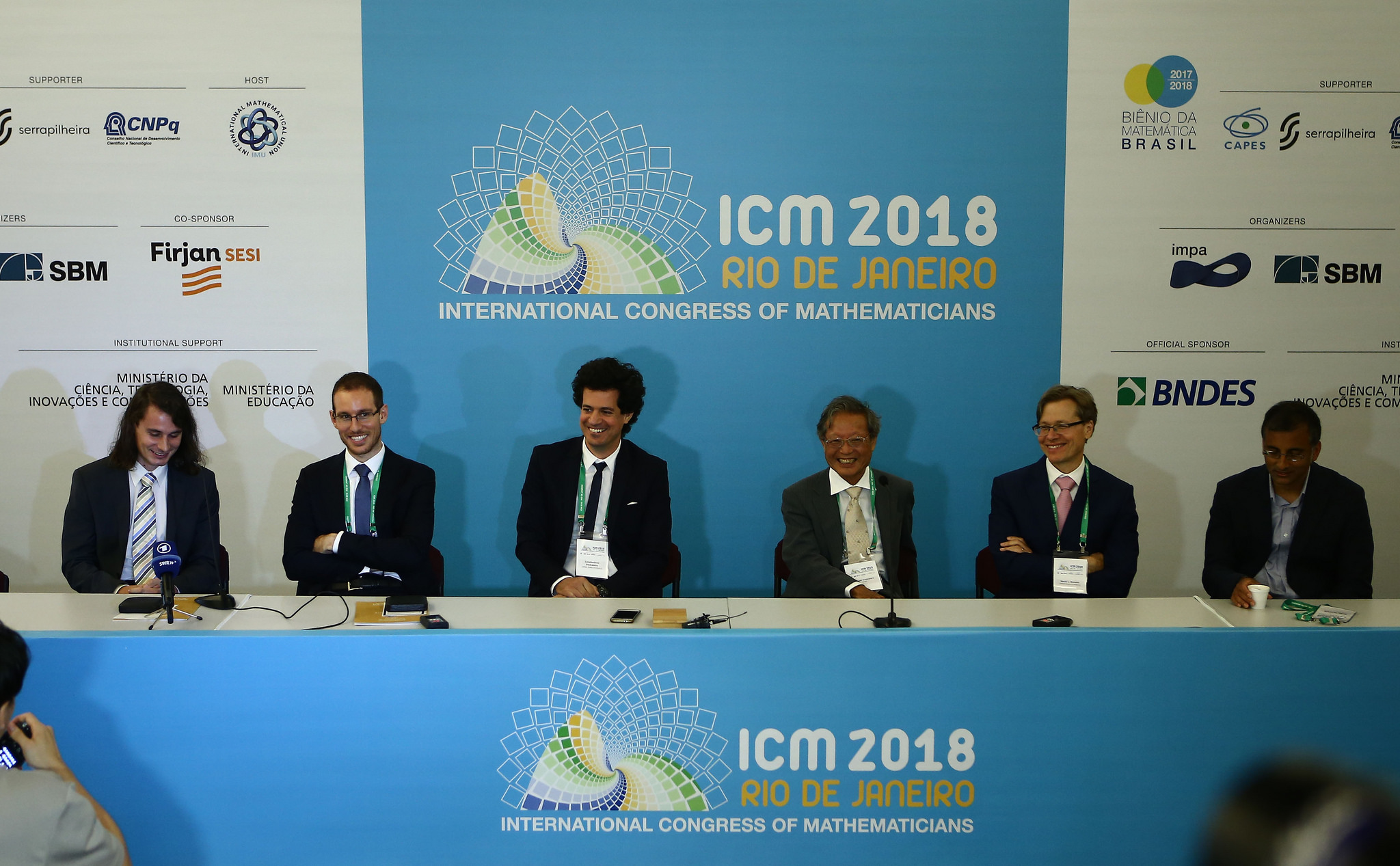
Alessio Figalli once solved a math problem at one in the morning, returning from a beer with friends. Peter Scholze won his first Math Olympiad as a child and always thinks his lucky streak will end. For Constantin Dakalakis, the difference between winning a prize and solving a math problem is that winning the prize didn't come after months and months of frustration with trial and error.
The winners of the main Mathematics prizes of 2018 spoke to the international press in the early afternoon of this Wednesday (1st), after the opening ceremony of the International Congress of Mathematicians (IMC), alongside veterans David Donoho, who won the Gauss prize, and Masaki Kashiwara, winner of the Chern medal.
Read also: OBMEP medalists attend awards ceremony at ICM 2018
Ali Nesin wins the Leelavati award at ICM 2018
Music, dance and awards at the opening of ICM 2018
For the winners, the research that placed them at the forefront of global mathematical knowledge is not an end point.
“Mathematicians evolve with society,” said Dakalakis. “The further we advance, the more new challenges arise.”
According to him, we are in a kind of golden age of mathematics. His research is a good example of this: with the computing power made possible by computer science, he managed to solve a six-decade-old problem in less than a year. Today, one of his interests is artificial intelligence.
David Donoho, winner of the Gauss Medal in Applied Mathematics, said he was happy for about five minutes when, in his youth, he solved the problem that brought him notoriety. Immediately afterwards, he began to think about the new problems opened up by that discovery.
What truly made Donoho proud was realizing that the problem he solved had applications for improving the accuracy of magnetic resonance imaging, years after its resolution. "On my own, I wouldn't have been able to do the things that have been done as a result of my work," he said.