Hans Donner reveals IMPA's influence on Globo and Dreamworks.

Cecilia Manzoni
In the 1980s, Fantástico, one of TV Globo's highest-rated programs, impressed its viewers with highly produced and futuristic images created using innovative computer graphics techniques as the opening sequence. The opening became an icon of Brazilian television, but what many people don't know is the influence of theories developed at IMPA (Institute for Pure and Applied Mathematics) behind the images. This was revealed on the 11th by Austrian designer Hans Donner, author of this and other memorable opening sequences for Brazilian programs, during his appearance on the talk show "The Noite com Danilo Gentili" .
According to Hans Donner, when developing the famous Fantástico vignette with a huge golden pyramid being traversed by beams of light in the colors of the rainbow , the Chinese mathematician Richard Chuang, owner of the company Pacific Data Image (PDI) and collaborator of Globo at the time, frequently consulted the book " Differential Geometry of Curves and Surfaces ", authored by the emeritus researcher of IMPA, Manfredo do Carmo (1928-2019).
“The most incredible thing was that I was working with this Chinese guy, Richard Chuang, who did the numbers and mathematical calculations. I kept bothering him because nothing had ever been done at the level I wanted. I wanted more metallic images, a more beautiful rainbow, and he couldn't handle it. And every time I insisted more, he would disappear with a book. One day I said, 'What book is that?'” Donner recounted in the interview, broadcast on the SBT channel.
Chuang's response surprised the designer. "It was a book written by a mathematical genius who lived across from my office at Globo, in Jardim Botânico, a professor at the Institute of Pure and Applied Mathematics. He, a Chinese man who worked in Silicon Valley , where the computer graphics industry was born in earnest, used a book by a Brazilian neighbor of Globo to make the opening sequence of Fantástico happen."
Luiz Velho, the lead researcher at IMPA's Computer Graphics Laboratory (Visgraf), recalls the success Manfredo's book had at the time. "That book was the biggest bestseller in the field of differential geometry, adopted by all master's and doctoral programs in the US and Europe. It sold very well; it was the best available at the time. Curiously, it was written in English and later translated into Portuguese," he says.
A specialist in mathematics and computer graphics, Chuang encountered the book at university, Velho reported, and since then he frequently consulted it to build ingenious visual effects. "When Chuang was working on the Globo system, he consulted this book to study everything related to surface models, which used differential geometry. It stayed on his desk, like a reference book, to look up formulas, etc.," the researcher added.
Brazilian research has led to important advances in computer graphics.
The influence of Manfredo do Carmo's book also crossed national borders and reached some of the world's leading animation studios, exemplifying the leading role of research in Brazil in the global evolution of computer graphics. PDI, Richard Chuang's company in partnership with Glen Entis and Carl Rosendal, had been hired by TV Globo to help develop a three-dimensional computer graphics system for the broadcaster, allowing the creation of computer-generated images. The goal was to give the channel a new, more innovative identity with greater visual appeal, in a collaboration that would last about a year.
“The three partners at PDI wanted to start a company, but they needed investment. [The head of Globo's Research and Development Department] José Dias met them at SIGGRAPH and watched some of the films they were making on the computer. He then thought it would be a good option for his network to invest in this group,” recalls Luiz Velho.
After its time at Globo, PDI returned to operating in the United States. The expertise acquired with the Brazilian broadcaster caught the attention of several companies, and soon PDI was bought by Dreamworks, the American animation studio that would go on to produce the film Shrek (2001) and become Pixar's main competitor. Globo, on the other hand, possessed the technology and software to continue producing high-quality computer animation, but lacked the skilled professionals to operate them.
Velho, who at the time had already worked at the Media Lab of the prestigious Massachusetts Institute of Technology (MIT) and at Fantastic Animation Machine, and Jonas Gomes, a PhD from IMPA supervised by Manfredo do Carmo and a pioneer in using computers to visualize mathematical surfaces, were invited to lead the research and development group at Globo Computação Gráfica.
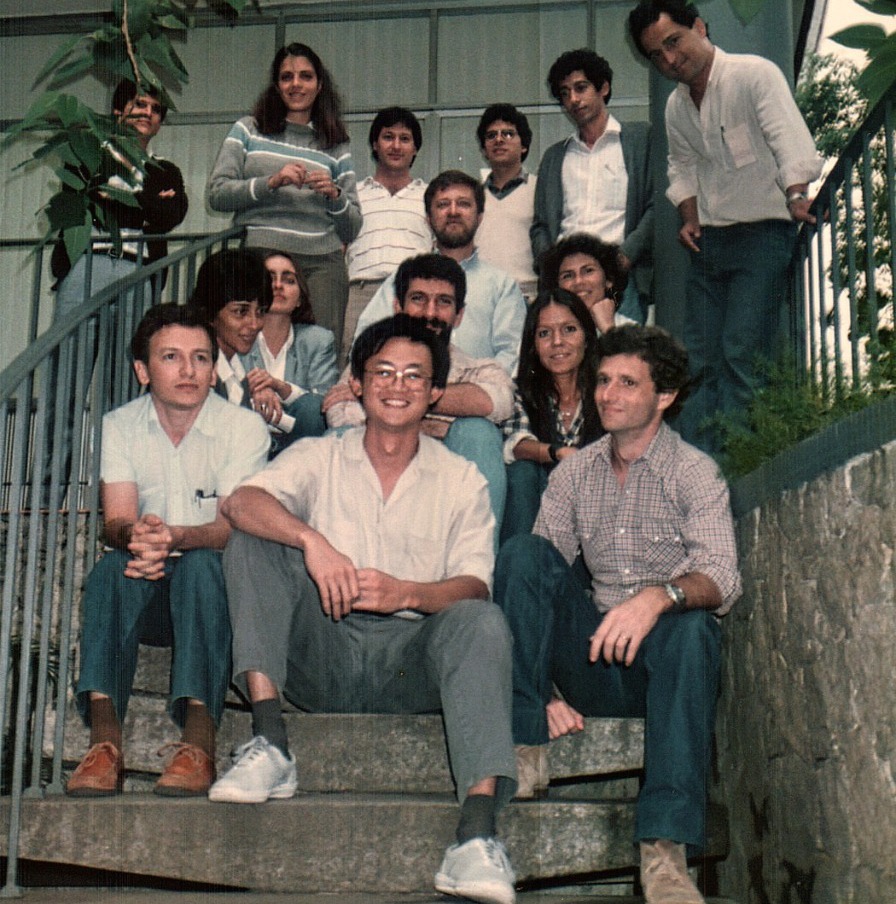
“This combination of Jonas’s talents with mine was very good because I had a great deal of experience in computer graphics, art, and design, and I had a good rapport with Hans Donner, in addition to a technical relationship with José Dias. Jonas was a mathematician with a vision for innovation, and at that time, we realized that any advancement in the field of computer graphics would be based on very sophisticated mathematics,” said the lead researcher of Visgraf in an interview with Mário Firmino Barreto da Costa , a historian from the Federal University of the State of Rio (Unirio).
Experience was the starting point for the creation of Visgraf.
After mastering the system left by PDI, the duo, along with a talented team, perfected the software and developed experiments and research in the field. According to Velho, this period was a "historic moment for computer graphics." "That was a new way of innovating in the audiovisual field using a technology made in a different way. Previous audiovisual technology was produced in industry, and this new technology was created through research."
The potential for undiscovered techniques in computer graphics led Gomes, current member of the IMPA Board of Directors, and Velho to create Visgraf in 1979. “At that time, we realized that research combining mathematics and computer graphics was beginning to emerge. Before, computer research was concentrated in engineering and computer science departments. It was much more about computer graphics work for industry.”

Today, more than 30 years later, the laboratory is a stronghold of mathematicians, designers, programmers, and computer scientists who execute innovative projects at the forefront of technology. Virtual reality, geometric modeling, data visualization, and image processing are part of Visgraf's daily routine, which seeks to anticipate future societal demands in the fields of technology and media. And, once again, to replicate them for the world.