Bees solve math problems without using numbers.
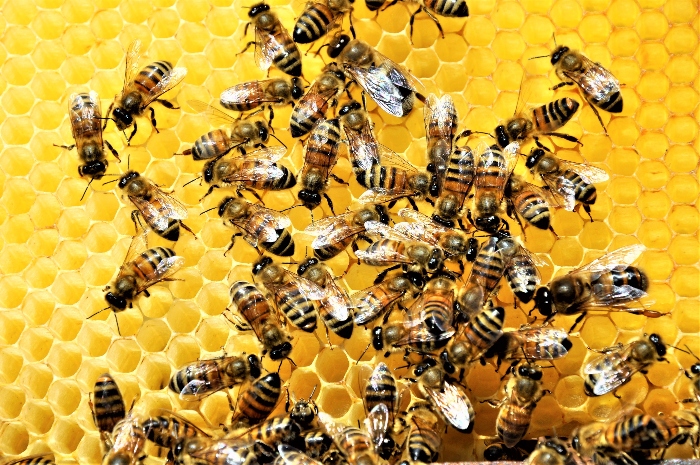
Foto: Freepik
The structural complexity of beehives and the different hierarchical levels among bees already indicated how intelligent these insects can be. But a recent study by researchers at the University of Sheffield (United Kingdom) shows that bees also possess the cognitive ability to solve mathematical problems through visual cues, without using any numbers. This discovery could be used to create more sophisticated artificial intelligence machines based on the brains of these animals, which have found the simplest and most efficient way to perform a task.
Published in February in the journal Proceedings of the Royal Society B , the research trained bees individually to identify posters with different numbers of shapes. One group of bees learned to find a sugary reward on posters displaying the highest number of shapes, while another group learned to find the sugary reward on posters with the lowest number of shapes.
Read more: 'Mathematics saved my life,' says Brazilian at Stanford.
In an interview with Gazeta, Viana questions the 'decolonization of mathematics'.
'Mathematics is an inexhaustible gold mine,' says Marcelo Viana.
Once the bees learned the rule, they were able to quickly identify the poster with the greater or lesser number of shapes to find the reward. Easier for the insects' brains to process, visual cues were the most efficient way the bees found to solve the test.
To confirm that the animals were not using numerical cues, they were tested with two pairs of posters containing the same number of drawings, but varying in some aspects, such as border length and spatial distribution. The researchers observed that bees trained to find the greatest number of shapes still flew to the posters with more variables, and those conditioned to find the posters with fewer drawings headed towards those with fewer variables, regardless of the number of illustrations.
“This doesn’t mean that bees or other non-verbal animals don’t understand numbers, but it suggests that animals use non-numerical properties to solve mathematical problems they often face if this information is available. However, we hope that our study will provide insight into better methods for exploring mathematical cognition in animals,” said Professor HaDi MaBouDi of the University of Sheffield, lead author of the paper, in an interview with the institution’s website .
Using numbers is a powerful cognitive ability of human beings that current artificial intelligence approaches are still unable to replicate in their full sophistication. Since animals are often good at finding efficient and unexpected solutions to problems, discovering which of their shortcuts can be useful for the development of autonomous machines is a task worth the effort.
With this potential application in mind, and committed to measuring the effectiveness of the non-numerical strategy for bees, the study's authors created a model based on known details of the bee's brain. And the results were positive: the model managed to solve other numerical tasks similar to those of the bee without processing numbers.
Source: University of Sheffield
Read also: Pedro Campos and mathematics: a serene love story
IMPA's Director-General speaks about Euler and the Empress of Russia.